
You know the sound. A clunk on every stitch, loops of thread nesting under the fabric, and a project that was supposed to be finished tonight. Bobbinwise exists for that moment, the one where you are sitting at your machine and just want it to sew again.
We write setup and troubleshooting guides for home sewing machines, organized by brand, then model, then problem. No long articles about sewing history first. You land on the exact fix for your exact machine, in plain steps, and you get back to your project.
This page explains how we work, why our guides look the way they do, and who we write them for.
Why we exist
Our mission: get you sewing again tonight
Every guide on Bobbinwise starts with what you see and hear at the machine. Loops under the fabric usually mean an upper threading problem, not a bobbin problem. A bird's nest of thread under the needle plate usually means the presser foot was down while threading, so the tension discs never opened. We write the symptom first because that is how you search, and it is how a repair tech starts.
Each guide opens with an At a glance box: the symptom, the likely cause, the time it takes, the tools you need, and a plain answer on whether it is safe to do yourself. If a fix belongs at a repair shop, we say so. A seized handwheel on a vintage machine or timing that has slipped is a shop job, and we would rather tell you that than have you make it worse.
We do not sell machines, and we do not take money to say nice things about them. When we recommend a machine, we name a budget band and one honest drawback, because every machine has one.
How every fix guide is built
Rethread, top and bobbin
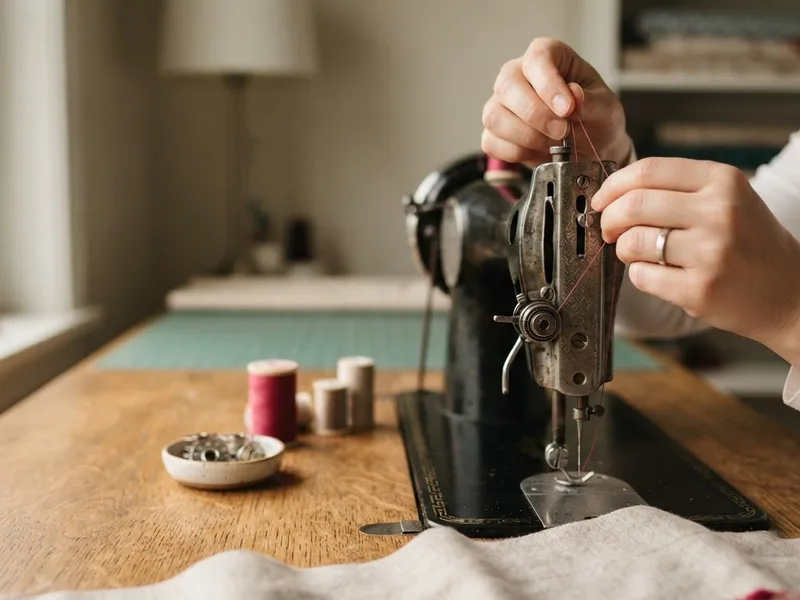
Step one is always a full rethread, with the presser foot up so the tension discs open and the thread seats between them. Most mystery problems end right here. You should feel the thread pull with light resistance when the foot goes down.
Fit a fresh needle
A bent or blunt needle causes skipped stitches, puckering and thumping sounds. We tell you the exact size, for example a 90/14 for quilting cotton, and which way the flat side faces on your machine.
Check the bobbin
The bobbin must match your model, wind evenly, and turn the right direction in the case. We show you what a correctly seated bobbin looks like before you touch any dial.
Then, and only then, adjust tension
Tension dials get blamed for everything, but they are the last thing a tech touches. We start you at the standard setting, usually 4, and tell you exactly what balanced stitches look like on both sides of the fabric.
Who Bobbinwise is for
You might be a beginner with a first machine in the 100 to 400 dollar range, and the manual reads like it was written for someone else. You might have inherited a machine without a manual at all, a grandmother's Singer with a serial number you want to decode.
You might be a quilter or an Etsy maker who cannot lose a week of sewing to a tension problem. You want the fix in ten minutes, in plain steps, with the part names explained the first time they appear.
You might be moving into machine embroidery and hitting a wall of new terms: stabilizer, hooping, file formats like PES, DST, JEF, EXP and VP3. We have a dedicated cluster for that, written at the same calm pace.
What you can expect from us
- Guides organized by brand, then model, then problem, so you land on the exact answer.
- An At a glance box on every fix: symptom, likely cause, time, tools, and whether it is safe to do yourself.
- Steps in the order a repair tech works: rethread, fresh needle, correct bobbin, then tension.
- Honest buying advice with budget bands and one stated drawback per machine, never hype.
- Vintage Singer help with serial number dating and realistic value ranges, no collector-price promises.
- Clear embroidery help covering tension, stabilizer, hoops and file formats.
Our promise to you
The way we write, and why
We are concrete because vague advice wastes your evening. We say a 90/14 needle, not the right needle. Tension dial at 4, a 2.5 mm stitch length, one drop of sewing machine oil on the race, not oil it regularly. After each step we tell you what you should see or hear, so you know whether it worked before you move on.
Fabric measurements come in inches and yards, the way US fabric stores sell them. Stitch settings come in millimeters, the way your machine shows them. Needle sizes come in both systems, because the packet often shows one and the manual the other.
And we stay honest about limits. If your machine needs a timing adjustment, a new motor belt fitted inside the body, or electrical work, that is a repair shop job. We will help you describe the problem clearly when you call, which is often the hardest part.
Tell us what your machine is doing
Stuck at your machine right now, or have a question about a guide? Write to us and tell us the brand, the model, and what you see and hear. We will point you to the right fix.